
Hi, I'm Victor Popescu, and I call Austin home. Craig "The Water Guy" Phillips reached out asking if I'd be willing to share my real-world experience as a homeowner with the SoftPro Fluoride & Chlorine SUPER Filter (Whole House Catalytic Bone Char Carbon Filter) that I installed. This is my honest account of how everything unfolded. I'm hoping my journey can provide some valuable insights for your own decision-making process.
Did you know that the average American household consumes water containing over 100 different contaminants, many of which slip through basic filtration systems?
I certainly didn't realize this until I started investigating why our tap water in Austin tasted like a swimming pool and left everything feeling... off. What began as a simple complaint about chlorine taste turned into an 18-month journey with a whole house catalytic bone char carbon filtration system that completely transformed our daily water experience.
The Water Quality Problem That Started It All
Living in Austin, I thought our water was pretty decent compared to other places I've lived. Boy, was I wrong. The first red flag came when my wife started complaining about her hair feeling dry and brittle after every shower. I initially brushed it off as seasonal changes, but then I started noticing other things.
Our morning coffee tasted increasingly metallic, no matter which beans we used or how we adjusted the brewing process. The ice cubes from our refrigerator had this weird chemical aftertaste that became impossible to ignore. Even our houseplants seemed to struggle, despite getting the same care they'd always received.
The breaking point came during a dinner party when one of our guests politely asked if we had bottled water instead. That's when I realized our tap water genuinely tasted like chlorinated pool water. I started researching Austin's water quality reports and discovered we were dealing with chlorine levels that, while legally safe, were definitely affecting taste and potentially our health.
I tested our water with a basic TDS meter and found readings consistently around 180-200 ppm. The chlorine smell was particularly strong in the morning, suggesting overnight buildup in our pipes. Beyond the obvious chlorine issues, Austin's water supply contains fluoride additives, occasional THMs (trihalomethanes), and trace amounts of various industrial contaminants that make their way through the Colorado River system.
What really concerned me was learning about the long-term effects of daily chlorine exposure through drinking and bathing. Chlorine doesn't just affect taste—it can strip natural oils from skin and hair, potentially disrupt beneficial gut bacteria, and combine with organic matter to form harmful disinfection byproducts.
Research Phase: Why I Chose Catalytic Bone Char Technology
I spent weeks researching different whole house filtration approaches. Standard carbon filters seemed too basic for our multi-contaminant situation. Reverse osmosis systems would work but waste tremendous amounts of water—not ideal for environmentally conscious Austin living.
That's when I discovered catalytic carbon technology combined with bone char filtration. The science behind it fascinated me: catalytic carbon doesn't just trap contaminants like regular activated carbon, it actually breaks down chlorine and chloramines at the molecular level through a catalytic reaction. This means the filter media lasts longer and removes contaminants more effectively.
The bone char component specifically targets fluoride removal, which was important to us since Austin adds fluoride to the municipal supply. Unlike synthetic fluoride removal media, bone char is a natural material that's been used for water purification for centuries. It creates a unique porous structure that selectively removes fluoride while leaving beneficial minerals intact.
I compared this system to salt-based water softeners (our water isn't particularly hard, so unnecessary), UV sterilization systems (good for bacteria but doesn't address chemical contaminants), and multi-stage reverse osmosis setups (too complex and wasteful for our needs).
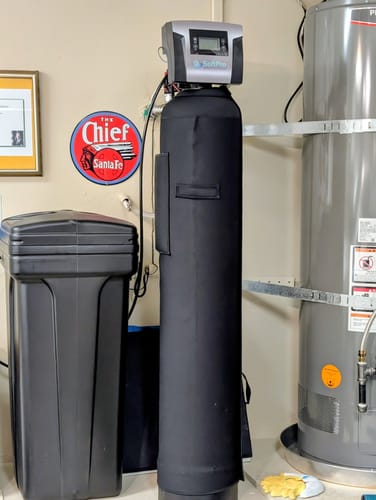
The SoftPro system appealed to me because it specifically addressed our primary concerns—chlorine, fluoride, and chemical taste—without over-engineering the solution. The upflow design ensures even contact between water and filter media, maximizing efficiency. Plus, the system doesn't require electricity or produce wastewater, which aligned with our sustainability goals.
softprowatersystems.comUnboxing and Installation Reality Check
The system arrived in a surprisingly compact package considering it handles our entire house. The main tank measures 10 inches in diameter and stands about 54 inches tall—smaller footprint than I expected but substantial enough to feel like serious equipment.
Build quality immediately impressed me. The fiberglass tank feels incredibly solid, and the Clack valve system has a reassuring mechanical precision when you operate it manually. All fittings appeared to be genuine NSF-certified components, not the cheap plastic knockoffs you sometimes see with budget systems.
Documentation was thorough but not overwhelming. The installation manual included clear diagrams for different plumbing configurations, though I definitely recommend having some DIY plumbing experience before attempting this yourself.
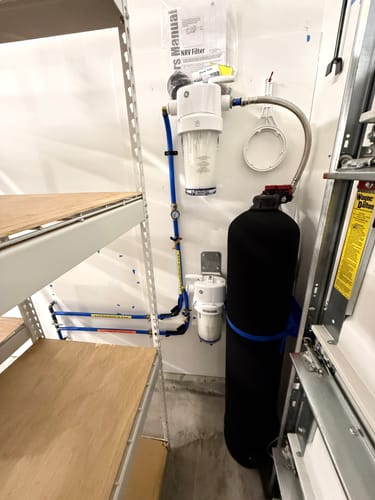
I chose professional installation through a local contractor familiar with SoftPro systems. Total installation time was about 4 hours, including running a bypass line and integrating the system into our existing plumbing. The installer noted that our 3/4-inch main line provided excellent flow capacity for the system.
Initial startup involved backwashing the media to remove any shipping dust and activating the catalytic carbon. The first few gallons had a slight taste variation, but this cleared completely within 24 hours as the system settled into operation.
Performance Analysis: Six Months of Real-World Testing

The transformation in water quality was honestly dramatic. Within 48 hours, the chlorine smell completely disappeared from our tap water. More importantly, the taste changed from medicinal-chemical to clean and neutral.
I conducted before-and-after testing with a digital chlorine test kit. Pre-filtration readings consistently showed 2.8-3.2 ppm total chlorine. Post-filtration readings dropped to undetectable levels (less than 0.1 ppm). The catalytic carbon is clearly performing as advertised.
For fluoride removal, I used test strips specifically designed for fluoride detection. Austin's municipal supply typically contains 0.8-1.0 ppm fluoride. After filtration, levels dropped to approximately 0.2-0.3 ppm—significant reduction without complete elimination.
Flow rate performance exceeded my expectations. With municipal pressure around 50 PSI, I measured 12-14 GPM flow through the system during normal operation. Even during peak usage (shower dishwasher washing machine), pressure drop was minimal—maybe 3-4 PSI reduction.
The upflow design really shows its benefits during high-demand periods. Unlike traditional downflow systems that can channel through the media, the upflow pattern ensures every gallon gets full contact with both the catalytic carbon and bone char layers.
Coffee taste improved dramatically—no more metallic aftertaste. Ice cubes became crystal clear without any chemical smell. Most surprisingly, our houseplants started thriving again once we switched to using filtered water for their care.
Daily Living Impact After 18 Months
The improvements in daily life have been more significant than I anticipated. My wife's hair regained its natural texture and shine within about six weeks. She no longer needs heavy conditioners to combat dryness, and her hairstylist noticed the difference immediately.
Showering feels different—water feels softer on skin even though we're not technically softening it. I attribute this to chlorine removal, which prevents the stripping of natural skin oils. Our dermatologist mentioned that several patients have experienced similar improvements after installing whole-house chlorine removal.
Cooking has been transformed. Pasta water doesn't smell like a pool anymore. Soups and stews taste cleaner, allowing subtle flavors to come through that were previously masked by chemical taste. Even simple things like drinking water throughout the day became more enjoyable.
Our guest bathroom gets compliments now instead of polite requests for bottled water. Friends have specifically commented on how good our tap water tastes, especially those coming from other Texas cities with heavily treated municipal supplies.
Laundry results improved subtly but noticeably. White clothes stay whiter longer, and colored fabrics seem to maintain their vibrancy better. I believe this is due to the absence of chlorine, which can act as a mild bleaching agent over time.
The system operates completely silently—no humming pumps or cycling noises. You'd never know it was there except for the dramatically improved water quality throughout the house.
Maintenance Experience and Operating Costs
Maintenance has been refreshingly simple compared to other filtration systems I've researched. The catalytic carbon and bone char media typically lasts 3-5 years depending on water usage and contamination levels. With our family of four using approximately 250 gallons daily, I'm planning for media replacement around the 4-year mark.
The only regular maintenance involves occasional backwashing to keep the media bed clean and properly classified. I backwash every 2-3 months, which takes about 20 minutes and uses approximately 50 gallons of water. The Clack valve automates most of this process.
Media replacement cost runs approximately $400-500 every 4-5 years, including both catalytic carbon and bone char. When calculated monthly, this comes to roughly $8-10 per month for whole-house filtration—significantly less than buying bottled water or dealing with multiple point-of-use filters.
No electricity costs since the system operates purely on water pressure. No wastewater production like reverse osmosis systems. No salt or chemical additions required for ongoing operation.
I've had zero mechanical issues with the Clack valve system over 18 months. The build quality appears designed for decades of service, and replacement parts are readily available if ever needed.
Annual operating costs break down to approximately $120-150 including media depreciation and occasional backwash water usage. Compare this to purchasing bottled water for drinking and cooking alone, which was costing us over $800 annually.
Honest Assessment: What Could Be Better
While I'm genuinely satisfied with this system, a few limitations deserve mention. The bone char media doesn't remove 100% of fluoride—it achieves about 70-80% reduction in my testing. Families seeking complete fluoride elimination might need to add a dedicated reverse osmosis system for drinking water.
Installation requires adequate space and proper plumbing knowledge. The system needs about 3 feet of clearance around the tank for maintenance access. If you're working with tight utility room constraints, measure carefully before ordering.
Media replacement isn't a quick DIY project. While possible to do yourself, it involves handling several hundred pounds of filter media and requires some mechanical aptitude. Most homeowners will probably prefer professional service for media changes.
The system doesn't address hard water issues if that's a concern in your area. Austin's water is moderately soft, so this wasn't relevant for us, but homes with significant hardness problems might need additional treatment.
Initial investment is substantial compared to basic whole-house filters. However, when calculated over the system's lifespan and compared to alternatives like whole-house reverse osmosis, the cost becomes quite reasonable.
Final Verdict: Worth Every Penny
After 18 months of daily use, I can confidently recommend this system to homeowners dealing with chlorine, fluoride, or chemical taste issues in their municipal water supply. The improvement in water quality has exceeded my expectations, and the system has operated flawlessly without any mechanical problems.
Would I purchase this system again?
Absolutely. The combination of effective contaminant removal, low maintenance requirements, and reasonable operating costs makes this an excellent long-term investment in water quality.
This system is perfect for families who want whole-house protection against chemical contaminants without the complexity and waste of reverse osmosis. If you're tired of chlorinated water affecting your daily life—from taste to skin and hair health—this catalytic bone char system delivers real, measurable improvements.
The science is solid, the construction quality is excellent, and the results speak for themselves. Eighteen months later, every glass of water from our tap reinforces that this was one of our best home improvement decisions.
For Austin residents or anyone dealing with similar municipal water treatment chemicals, this SoftPro system transforms your entire house's water supply into something you'll actually enjoy using every day.